October 6, 2026
Rebranding Guide: When and How to Do It Right
A practical rebranding guide that explains when it's time to rebrand, how to do it without losing clients, and what mistakes to avoid.
Published On: August 21, 2026
Published By: Designocracy

A web development company in New York builds and maintains websites, web apps, and online stores for NYC businesses covering strategy, UI/UX design, front-end and back-end development, e-commerce, and SEO. NYC rates typically run higher than the national average, so the real question is not "who is closest?" but "what am I actually paying for?" Judge any agency on three things: relevant portfolio work, transparent pricing, and who owns your site after launch.
Search "web development company in New York" and you will get thousands of results, all promising the same things. Award-winning. Results-driven. Full-service. After a while, every agency site starts to read like a copy of the last one.
This guide takes a different approach. Instead of another list of agencies claiming to be the best, it explains what NYC web development actually costs, what drives those costs up, and the specific questions that separate a genuine partner from an expensive disappointment. Including the one question almost nobody thinks to ask.
The term gets used loosely, which is part of the confusion. A full-service New York web development company should cover more than code:
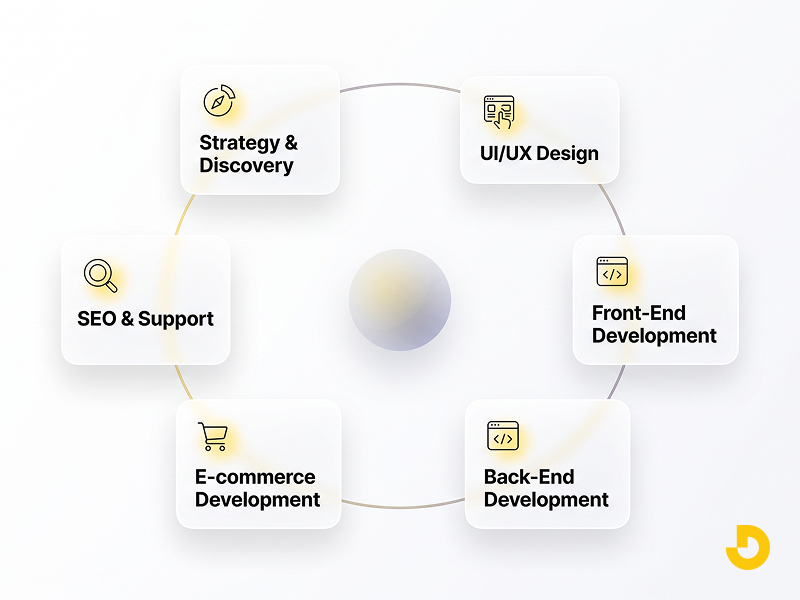
If a company only does the middle two, you are hiring a contractor, not a partner. That distinction matters more than any award badge on their homepage.
Pricing is where most NYC agency conversations get vague. Here is a realistic view of the market ranges, so you can spot a quote that is wildly off in either direction.
Typical NYC web development project ranges
| Project Type | Typical Range | Timeline | Best For |
|---|---|---|---|
| DIY builder (Wix, Squarespace) | $200 – $1,500 / yr | Days | Solo founders and idea-stage testing |
| Freelance developer | $2,000 – $10,000 | 3 – 8 weeks | Small brochure sites with a clear brief |
| Custom business website | $5,000 – $15,000 | 6 – 12 weeks | Established SMBs treating the site as a growth engine |
| E-commerce store | $10,000 – $40,000+ | 8 – 16 weeks | Retail and DTC brands selling at volume |
| Custom web application | $30,000 – $150,000+ | 4 – 9 months | SaaS, portals, and complex internal tools |
| Manhattan-based full-service agency | Often 1.5× – 2× the above | Varies | Enterprise budgets needing on-site presence |
Directional market ranges for planning. Always confirm scope and inclusions against a written quote see our full breakdown of what a website costs.
Here is the thing nobody in this industry says out loud.
In New York, a meaningful share of what you pay an agency is not talent. It is real estate, sales overhead, and the account layer between you and the person writing your code.
None of that is inherently bad. A Fifth Avenue office and a dedicated account team can be genuinely worth it — if you need in-person workshops, if your board expects a name-brand agency, or if your project is complex enough to warrant that structure.
But most businesses never audit it. They assume a higher NYC quote means better work, when often it means the same work with more overhead baked in. Meanwhile, the actual developers may be sitting in another state or another country regardless — a reality that has been true across this industry for years.
So the useful question is not "Is this agency in New York?" It is "Is the premium I'm paying buying me capability, or square footage?"
Be fair about this. Proximity earns its keep when you need frequent in-person strategy sessions, when your project involves on-location photography or events, when your industry has NYC-specific compliance considerations, or when your stakeholders simply expect a team they can meet in a room.
For most standard builds a marketing site, a Shopify store, a booking platform the work happens over Slack, Figma, and video calls whether the team is in SoHo or Sacramento. In those cases, you are paying for a zip code. What should actually decide your choice is portfolio relevance, communication quality, and whether the site performs after launch.
Get a clear, itemised quote scope, timeline, and what happens after launch.
Get a Free Project CodeThis is the part to actually use. Ask every agency on your shortlist these eight questions, then score each answer. Give 2 for a clear, specific answer, 1 for a vague one, and 0 for a dodge or a non-answer. Sixteen points available.
| Ask Them | What a "2-point" answer sounds like | Score |
|---|---|---|
| "Who writes the actual code, and where do they sit?" | Names the team and location plainly. No deflection. | __ / 2 |
| "Can I talk to a developer, not just an account manager?" | Yes, and they set it up without hesitation. | __ / 2 |
| "Who owns the code and the accounts after launch?" | You do. Full handover, no hostage situation. | __ / 2 |
| "Show me a site you built in my industry." | A live, relevant URL — not a mockup or a logo wall. | __ / 2 |
| "What is not included in this quote?" | A specific list. Vagueness here becomes an invoice later. | __ / 2 |
| "What happens if it launches and traffic doesn't convert?" | A concrete iteration or optimisation plan. | __ / 2 |
| "What does month 13 cost me?" | Clear hosting, maintenance, and support numbers. | __ / 2 |
| "Which parts of this quote are for overhead?" | An honest answer. This one is the tell. | __ / 2 |
0–7
Walk. Vagueness before you sign becomes surprises after you sign.
8–12
Worth a second conversation. Push hard on the low-scoring answers.
13–16
A real partner. Now compare on portfolio fit rather than price alone.
Run all three finalists through this. The scores usually separate them faster than the proposals do.
Platform choice drives cost, timeline, and how easily your team can update things later. There is no universally right answer.
WordPress remains the workhorse for content-heavy marketing sites. Shopify is the fastest path for most retail and DTC brands our guide on designing a Shopify website in six steps walks through it. WooCommerce gives more control if you already live in WordPress. Webflow and Framer suit design-led sites your marketing team can edit without a developer. Custom builds make sense when your product genuinely does not fit a template the territory our web app development work covers.

Whatever you choose, insist on responsive execution. Google indexes the mobile version of your site first, so a desktop-first build is a ranking problem before it is a design problem the fundamentals are covered in our guide to responsive web design.
New York's economy is unusually varied, and the right build looks different across it. Finance and legal firms need credibility, security, and compliance-aware design. Fashion and DTC brands need editorial visuals and a checkout that converts — the principles in our e-commerce design guide apply directly. Restaurants and hospitality need mobile-first booking above all else. Media and startups need speed, scale, and a platform that will not buckle at launch. Real estate needs search, filtering, and lead capture that actually works on a phone.

An agency that has built in your vertical will arrive with fewer assumptions to unlearn. Ask for that proof specifically.
If you are still shortlisting, our comparison of the best web design companies for small business lays out how to weigh agencies against each other, and our guide to landing pages that convert is a useful test of whether an agency understands conversion or just aesthetics.
The best web development partner for your New York business is the one that understands your market, shows you relevant work, quotes you honestly, and hands you the keys at the end. Sometimes that team is in Manhattan. Often it is not and in 2026, that matters far less than whether the site loads fast, ranks well, and turns visitors into customers.
Designocracy works with businesses across New York and the wider US from our Dover, Delaware base no Manhattan overhead, no account-layer telephone game, just direct access to the people building your site. If you want a straight answer on scope, cost, and timeline before you commit to anything, that is a conversation worth having.

Get a clear, itemised quote scope, timeline, and what happens after launch.
Start Your Project Today