September 30, 2026
How to Master SEO for Dentists: A Simple Guide to Getting More Patients
Mastering dental SEO helps your practice rank higher on search engines and turn local online searches into booked patient appointments
Published On: August 18, 2026
Published By: Designocracy
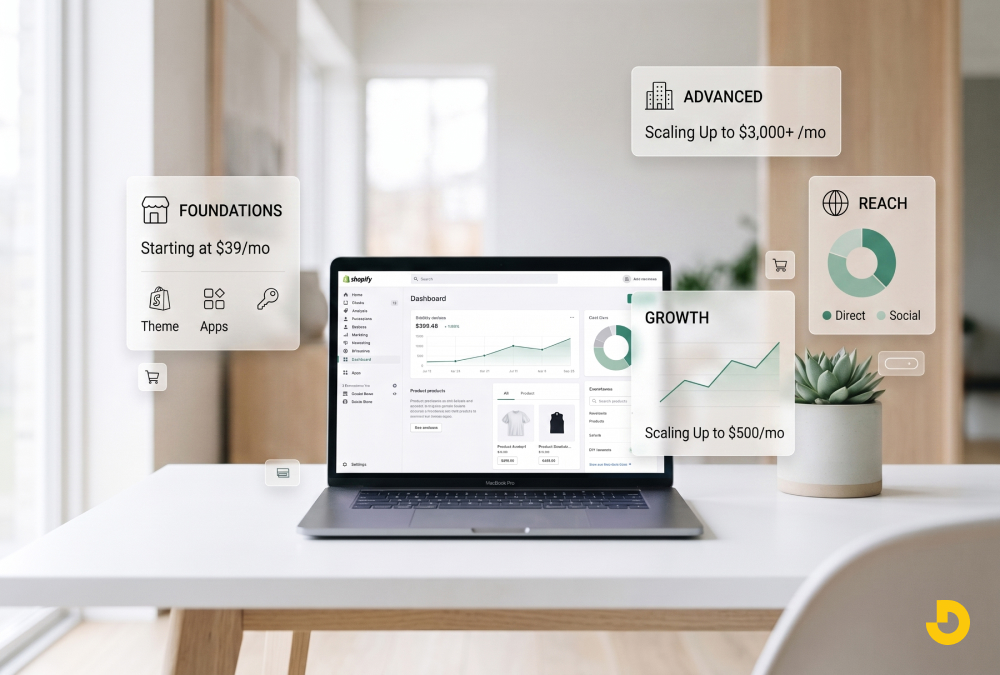
A Shopify store costs $39/month on the Basic plan, but that is only the entry ticket. Your real cost is the plan fee, plus card processing (about 2.9% + 30¢ per sale), plus a theme (free to ~$500 one-off), plus apps (roughly $0–$150/month for most small stores). A lean DIY store realistically runs $50–$150/month. A professionally built store adds a one-off design and development cost, typically $3,000–$15,000+ depending on complexity. Budget for the whole stack, not the sticker price.
Shopify plan prices below are US list pricing, checked July 2026. Shopify changes pricing and promotions periodically; confirm the live numbers on Shopify's pricing page before you commit.
Search "how much does a Shopify store cost" and you get one number back: thirty-nine dollars. That number is technically true and practically useless, because nobody has ever run a Shopify store for $39 a month and nothing else.
The plan fee is the entry ticket. The actual bill is assembled from four separate layers, and three of them are easy to miss until the invoices start landing. This guide breaks down all four with real 2026 figures, shows you what a professional build costs on top, and gives you a worksheet to calculate your own number instead of guessing.
Before any numbers, get the structure straight. Every Shopify store pays some combination of:
Most budgets go wrong because they plan for layer one and get surprised by layers two and four. Let's price each one.
Shopify runs several tiers. Note that the old middle plan, confusingly called "Shopify," was renamed Grow—so older guides referencing a "Shopify plan" mean this tier. Annual billing saves 25% across the three core plans.
Shopify plan costs, July 2026 (US list pricing)
| Plan | Monthly | Annual (per mo) | Card rate (online) | Best for |
|---|---|---|---|---|
| Starter | $5 | — | ~2.9% + 30¢ | Not a real storefront — checkout links for social selling only. |
| Basic | $39 | $29 | ~2.9% + 30¢ | New stores. A full storefront with everything you need to launch. |
| Grow | $105 | $79 | ~2.7% + 30¢ | Growing stores that need staff accounts and better reporting. |
| Advanced | $399 | $299 | ~2.5% + 30¢ | Scaling brands needing custom reports and international tools. |
| Plus | $2,300+ | — | Negotiated | Enterprise. Custom checkout, advanced B2B, high API limits. |
Rates vary slightly by region and are subject to change. Plus is typically quoted from $2,300/mo on a 3-year term.
Shopify also runs a short free trial followed by a promotional rate of roughly $1/month for the first three months on the core plans. That is genuinely useful for building before you pay — just diarise the date it ends, because the jump to full pricing catches people out.
There is no functional reason a launching store needs Grow or Advanced. Basic gives you a complete storefront, standard card rates, and app access. Upgrade when the maths says so — which brings us to the most useful thing in this article.
Most guides tell you to "upgrade when you grow." That is not advice; it is a shrug. Here is the actual calculation:
(Monthly card volume × rate difference) > (Plan price difference) = Upgrade
Worked example: Basic → Grow saves 0.2% on card fees but costs $66 more per month. You need $66 ÷ 0.002 = $33,000 in monthly card volume before the fee saving alone pays for the upgrade. Below that, you are upgrading for the features (staff accounts, reporting), not the savings—which is a fine reason, but know which one you are buying.
Your plan fee is fixed. Your transaction costs grow with every sale, which is why they eventually dwarf the subscription.
Using Shopify Payments, you pay only the card processing rate roughly 2.9% + 30¢ per online sale on Basic, dropping as you move up tiers. On a $100 order, that is about $3.20.
Use a third-party gateway instead, and Shopify adds its own fee on top: around 2% on Basic, 1% on Grow, and 0.6% on Advanced. This is the single most expensive avoidable mistake in Shopify budgeting. On a store doing $10,000 a month, that 2% penalty is roughly $200/month — more than five times the basic plan fee for no added benefit.
The rule is simple: use Shopify Payments unless you have a specific, costed reason not to.
This is the layer with the widest range, because it depends entirely on who does the work. A free theme with your logo dropped in costs nothing. A custom store built around your merchandising costs real money and usually earns it back.
Shopify build routes compared
| Route | Typical one-off cost | Timeline | Trade-off |
|---|---|---|---|
| DIY, free theme | $0 | Days | Cheapest and fastest, but looks like a template and your time is not free. |
| DIY, premium theme | ~$100–$500 | 1–2 weeks | Better looking and more flexible. Still recognizably a theme, still your labour. |
| Freelancer | ~$1,000–$5,000 | 2–6 weeks | Real customization at a lower cost. Quality varies widely; support ends at launch. |
| Agency build | ~$3,000–$15,000+ | 4–12 weeks | Strategy, design, CRO, and SEO are baked in. Higher upfront, built to scale. |
| Enterprise / Plus | $25,000+ | 3–6 months | Custom checkout, integrations, and migrations. Only worth it at serious volume. |
Ranges reflect typical market pricing. Get a written quotescope, not hours, drives the real number.
What actually pushes a build price up? Product count and variant complexity, custom functionality, migrating from another platform, integrations with your ERP or inventory system, custom design versus theme customization, and how much content and photography you need to produce. A ten-product store with a tuned theme is a different animal from a 2,000-SKU catalogue with wholesale pricing tiers.
If you want to sanity-check the numbers against the broader market, our guide to how much a website costs covers the same territory for non-commerce sites, and our walkthrough of how to design a Shopify website in six steps shows what the build process actually involves.
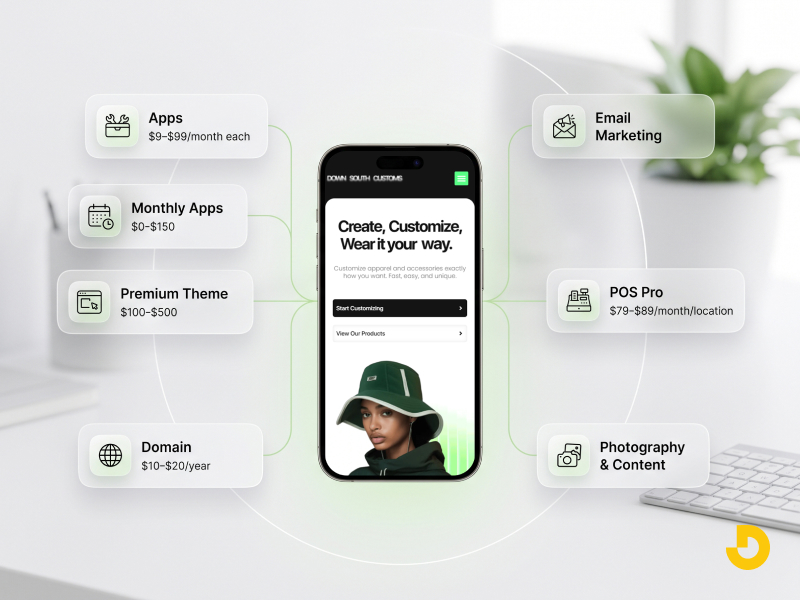
Shopify's app store is where budgets quietly leak. Individual apps look trivial — nine dollars here, nineteen there — and then you have eleven of them.
Audit your apps quarterly. Shopify keeps absorbing features that used to require apps, so the subscription you added two years ago may now duplicate something built in.
Here is the part you can actually use. Most articles give you averages; averages do not pay invoices. Fill in your own numbers and get your real twelve-month figure.
| Line item | How to work it out | Your number |
|---|---|---|
| Plan fee | Monthly plan × 12 (use the annual rate if committing) | $ ______ |
| Card processing | Expected yearly sales × your rate (e.g. 2.9%) | $ ______ |
| Gateway penalty | $0 if using Shopify Payments — otherwise sales × 2% | $ ______ |
| Theme | One-off: $0 free, or $100–$500 premium | $ ______ |
| Build / design | One-off: DIY $0, freelancer, or agency quote | $ ______ |
| Apps | Monthly app total × 12 | $ ______ |
| Domain | Roughly $10–$20/year | $ ______ |
| Content & photography | Shoot cost, or your own hours valued honestly | $ ______ |
| Year-one total | Add every row above | $ ______ |
Two rows decide almost everything: card processing (which scales with success) and the build (which is one-off but sets your ceiling).
Basic plan, free theme, Shopify Payments, two or three apps, DIY build. Roughly $50–$100/month plus processing. Viable, and how a lot of good stores start.
Basic or Grow, premium theme or a freelance build, a lean app stack, proper photography. Roughly $150–$300/month plus a one-off build in the low thousands.
Grow or Advanced, an agency-built custom store, a considered app stack, ongoing optimisation. Higher monthly spend and a meaningful upfront build — justified when your store is the primary growth engine rather than a side channel.
Honest answer: not always. If you are testing a product idea, a free theme and your own weekend is the right call. Spending $8,000 to validate an idea you might drop in three months is bad maths.
It becomes worth it when the store is the business. At that point a template's ceiling starts costing you more than the build would have. Generic checkout flows leak conversions, slow themes bleed rankings, and DIY structure makes SEO harder than it needs to be. A well-built store compounds: better conversion rate on the same traffic, better search visibility, fewer expensive rebuilds later. Our guide to SEO for e-commerce websites covers why the build and the rankings are the same conversation, and our top e-commerce design tips explain what "well built" actually means in practice.
At Designocracy, we build Shopify stores with that trade-off in the open — clear scope, clear pricing, and a build sized to where your business actually is rather than where a template thinks it should be.
Tell us your catalogue and goals. We'll give you a clear, itemised quote — no guesswork.
Start Your Project Today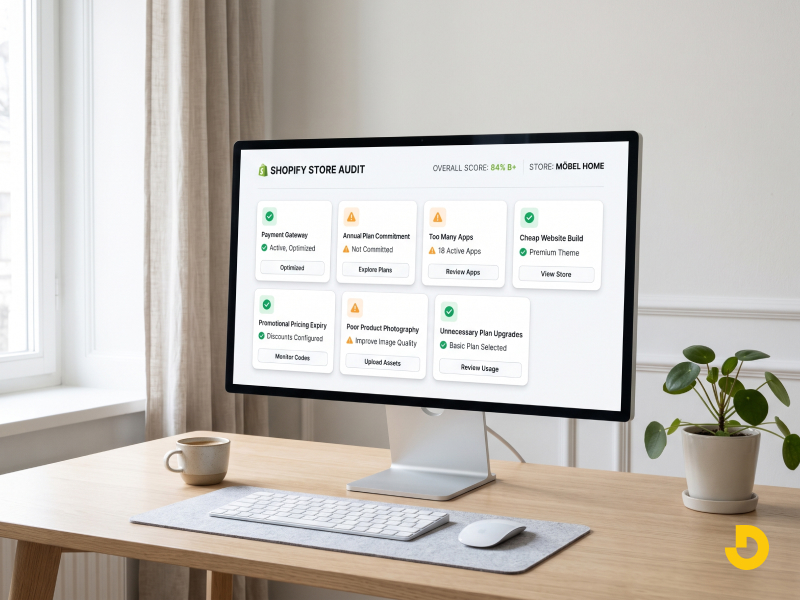
A Shopify store costs $39/month the way a car costs the sticker price. The plan fee is the smallest, most predictable part of your bill. What actually determines your spend is whether you use Shopify Payments, how disciplined your app stack is, and whether your store is a side experiment or your main revenue engine.
Run the worksheet. Get your real number. Then decide what the build is worth — with the whole picture in front of you instead of one marketing figure.
Before publishing: re-verify Shopify's plan prices against shopify.com/pricing on the publish date and update the July 2026 stamp. Confirm the build ranges match your own quoted pricing before this goes live. Point both CTA buttons at your live enquiry page, add the FAQ JSON-LD schema (supplied separately), and validate with Google's Rich Results Test.