
September 24, 2026
Local SEO Guide: How Small Businesses Can Dominate Google Maps
A practical local SEO guide for small businesses that want to rank higher on Google Maps. Real steps, no fluff, just what actually moves the needle.
Published On: September 30, 2026
Published By: Designocracy
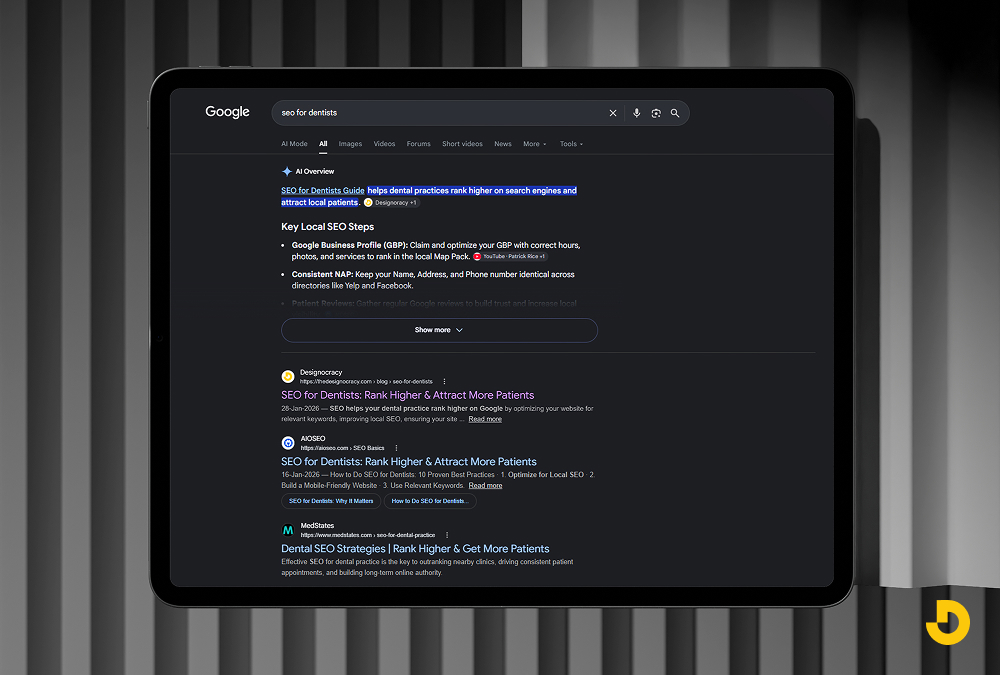
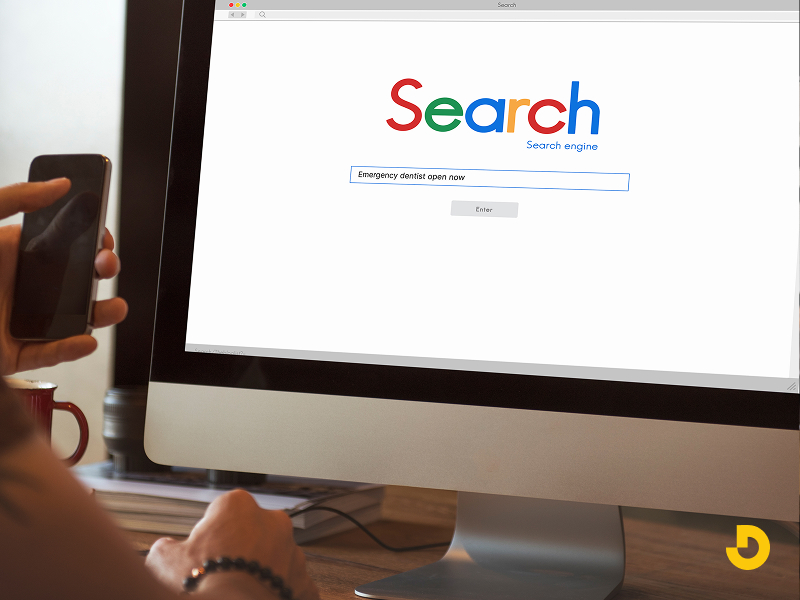
Dental practices don't lose patients to bad service nearly as often as they lose them to invisibility. If your practice isn't showing up when someone searches "dentist near me," you're handing those patients straight to a competitor. SEO for dentists isn't optional anymore—it's the primary channel most patients use to find and vet a new dentist before they ever call.
This guide covers a practical dental SEO strategy you can actually execute, step by step.
Not ranking for the searches your patients are already making?
Get a Free Dental SEO Audit →Yes, when it's built around how patients actually search. Dental searches are high-intent and largely local, which means local SEO for dentists consistently outperforms broad, unfocused content. Between the Google Local Pack, organic results, and AI Overviews now summarizing "best dentist" queries directly on the results page, a practice with weak dental website SEO is competing in an uneven field.
Patients find dentists through three main paths:
Getting found on all three requires both a strong Google Business Profile for dentists and a website built to support it.
This is the single highest-leverage move in any dental SEO checklist:

If you want the fundamentals behind this, this breakdown of local SEO for small businesses applies directly to dental practices.
Generic terms like "dentist" are brutally competitive and rarely convert on their own. Effective dental SEO keywords fall into a few groups:
If you're building your keyword list from scratch, this guide on how to find and choose the right keywords for SEO walks through the process.
Every core service (implants, whitening, Invisalign, emergency care) deserves its own page not a paragraph buried on a general "Services" page. This is foundational to any solid website design built for conversions, not just traffic.
Each page should include:
For every page on your site:
Want a dental website built to rank and convert?
Explore Web Design Services →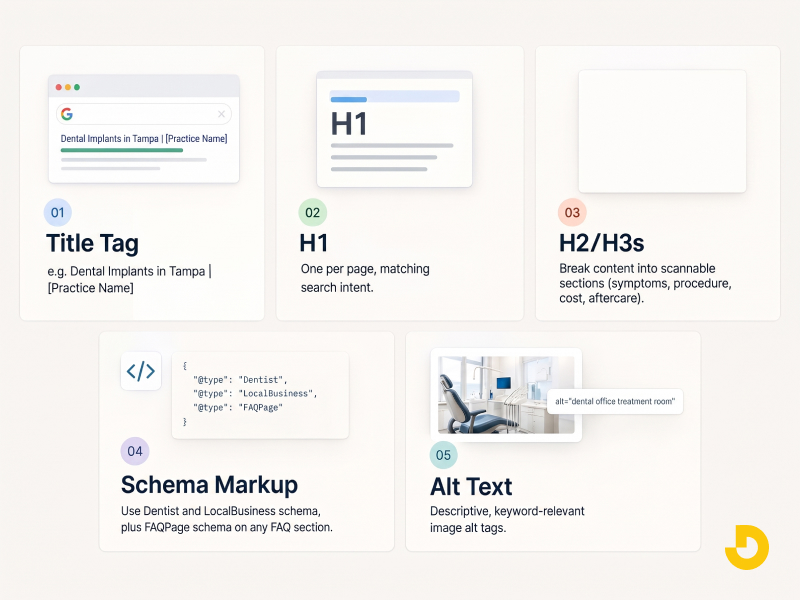
Blog content answering real patient questions—"Does insurance cover Invisalign?" and "what to expect after a root canal?"—builds topical authority and captures top-of-funnel traffic. This is also what earns citations in AI overviews, since these systems favor clear, direct answers over dense sales copy. This is the real engine for getting more dental patients without relying entirely on paid ads.
Blog posts that never link to a booking or service page are dead ends. Every informational post should link to the relevant service page, related educational content, and your local SEO page. For a deeper look at how to structure this correctly, see this guide to internal linking for SEO.
Reviews are both a ranking factor and a conversion factor. Set up a simple post-visit text or email asking for a Google review, and respond to every review — positive and negative.
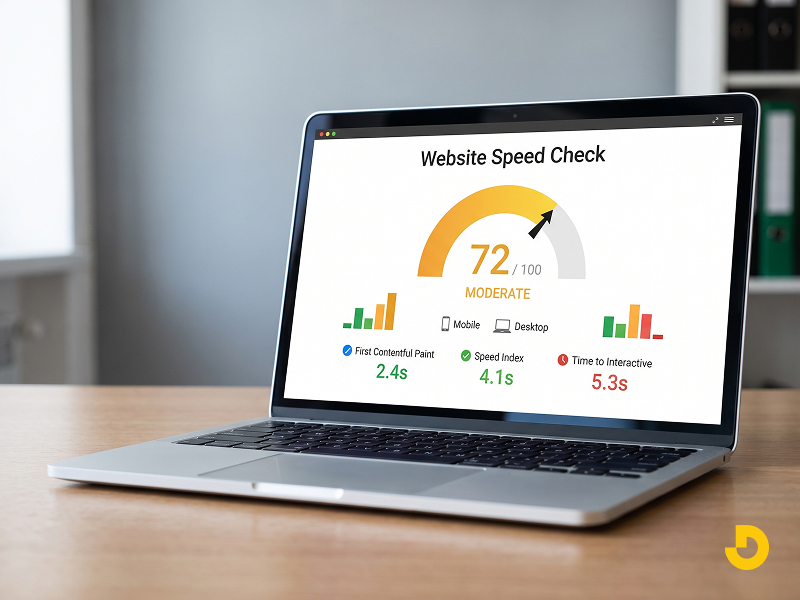
Dental sites are frequently slow due to heavy booking widgets and unoptimized images. Prioritize mobile speed under 3 seconds, compressed images, HTTPS, and a working online booking flow.
SEO is not instant, but progress follows a fairly predictable pattern. Here's a realistic month-by-month view:
| Timeframe | What's Happening | Expected Result |
|---|---|---|
| Month 1 | Google Business Profile optimization, technical fixes, keyword mapping | Minor local visibility gains |
| Months 2–3 | Service page builds, on-page SEO, first blog content published | Early keyword rankings appear. |
| Months 4–6 | Content library grows, internal linking expands, and reviews accumulate. | Local pack visibility, steady organic traffic growth |
| Month 6+ | Ongoing content, link building, conversion rate optimization | Consistent new-patient inquiries from organic search |
Quick reference for where most practices should start:
Costs vary based on competition and market size. If you're budgeting, this SEO pricing guide breaks down typical ranges before you talk to an agency.
Not every dental practice needs an in-house strategy. If you're evaluating agencies, this list of best dental digital marketing agencies is a useful starting comparison.
Ready to turn Google searches into booked appointments?
Talk to Our Dental SEO Team →