
September 15, 2026
UI vs UX Design: What's the Difference? (Simple Guide)
UI and UX design are not the same. This easy book explains the difference and provides real-world examples, so you know exactly what your project requires.
Published On: March 3, 2026
Published By: Designocracy

If you have used SEO tools, you have probably seen the metrics DR and UR. They show up in Ahrefs, and many people talk about them like they are the secret to ranking.
But what do they actually mean? And should you obsess over them?
Here is a quick, honest explainer. We will look at what DR and UR are, how they work, and where they fit into real SEO work. The Designocracy team uses these metrics daily, so this is based on practical use, not just theory.
Let us start with the simple version.
Domain Rating (DR) shows the strength of a website's overall backlink profile. It looks at all the links pointing to the entire domain. The score goes from 0 to 100. The higher the number, the stronger the link profile is supposed to be.
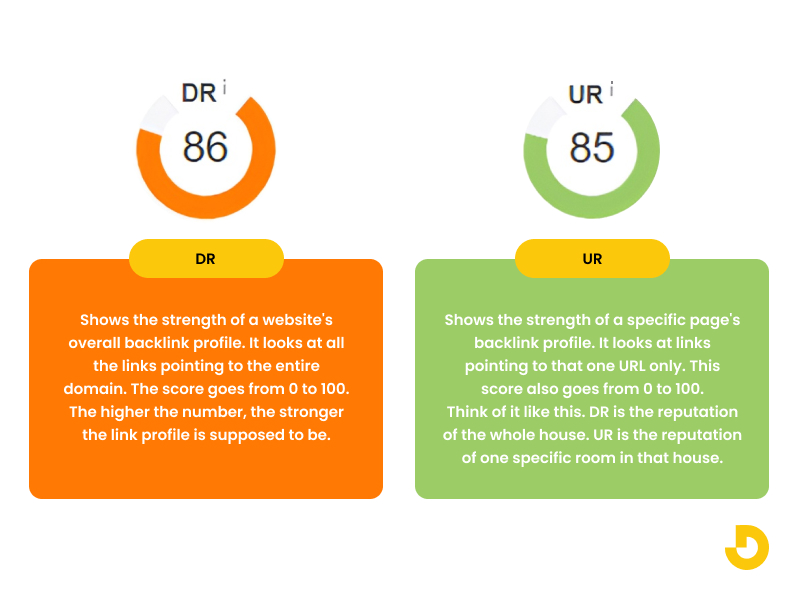
URL Rating (UR) shows the strength of a specific page's backlink profile. It looks at links pointing to that one URL only. This score also goes from 0 to 100.
Think of it like this. DR is the reputation of the whole house. UR is the reputation of one specific room in that house.
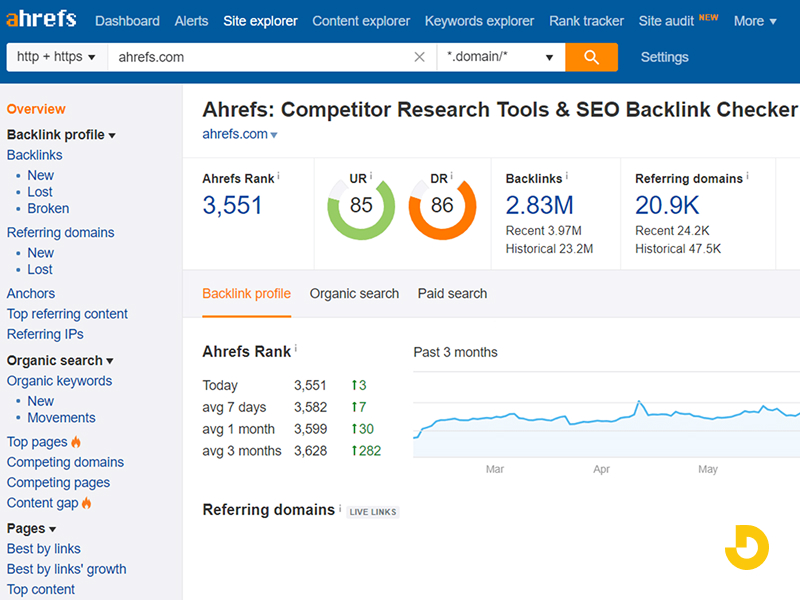
The way Ahrefs calculates these scores matters. It is not random.
According to Ahrefs, DR works like this:
First, they look at how many unique domains link to the target website with dofollow links. Then they consider the DR of those linking domains. They also check how many other sites each of those domains links to.
After some math, they plot everything on a 0 to 100 scale.
Here is the important part. Ahrefs indexes more links than many other tools. I have seen this myself. When we check sites at The Designocracy, Ahrefs consistently finds more backlink data than competitors. This makes DR a solid indicator of link profile strength.
But there is a catch. The calculation is much simpler than Google's algorithm. Google uses hundreds of factors. DR only looks at links.
UR follows the same basic idea but focuses on one page. It looks at how many unique domains link to that specific URL. It also considers the authority of those linking domains.

Many people think raising UR will automatically make a page rank higher. That is not always true.
Here is where things get real. A high DR score does not mean a site will rank for every keyword.
I remember an example from Wil Reynolds. He talked about a site that got a link from the New York Times. The site had high authority coming from a major publication. But it still did not rank well.
Why? Because the sites already ranking were satisfying users. When people searched, they clicked those results and did not come back to Google. Google noticed this. The algorithm saw that users were happy with those results.
A link from the New York Times could not change that. User satisfaction mattered more.
At The Designocracy, we see this often. Some sites with moderate DR outrank sites with much higher scores. They simply give users what they want.
UR shows similar behavior. You would expect pages with high UR to rank at the top. But real search results tell a different story.
Take a look at search results for almost any local term. The Designocracy team analyzed rankings for various keywords. The URL ratings were all over the place. Some top results had low UR. Some lower results had high UR.
There was no clear pattern.
This matters because some SEOs chase UR like it is the goal itself. They build links to a specific page, thinking it will push them to position one. Sometimes it helps. But it is not a guarantee.
Rankings depend on many things. Content quality matters. User engagement matters. Does the page answer the question? Do people stay on the page or bounce back to search?
Google watches all of this. A link is just one signal among many.
So if DR and UR do not determine rankings, why use them? They still have value when used correctly.
DR helps with competitor analysis. You can look at top ranking sites and see the strength of their backlink profiles. If every site on page one has DR 70 and you are at DR 20, you know link building should be a priority.
UR helps identify strong content. If a page has high UR, it means other sites found it valuable enough to link to. You can study those pages and understand what made them link-worthy.
Both metrics help prioritize link prospects. When looking for sites to reach out to, higher DR sites often pass more value. But relevance matters more than raw score. A link from a relevant site with DR 30 is usually better than a link from a random site with DR 70.
At The Designocracy, we use these numbers as signals, not targets. They guide our strategy but do not define success.
Here is a practical approach to working with these metrics.
Do not optimize for DR. Building links to raise a number misses the point. Build links to bring value to users. If you create something useful, people will link to it naturally.
Look at UR trends over time. When you publish a new piece of content, watch how UR changes. If it stays flat, maybe the content is not attracting links. That feedback helps you improve.
Compare DR to actual rankings. Check if high DR sites dominate your target keywords. If they do, you need a strong link strategy. If lower DR sites are winning, focus more on content and user experience.
Remember what Google values. Experience matters. Expertise matters. Authoritativeness and trust matter. Backlinks contribute to authority, but they are not the whole story.
The Designocracy approach combines link data with real user signals. We ask: Does this content help people? Does it answer their questions? Does it keep them engaged?
When those things are true, rankings often follow.
| 🔍 DR (Domain Rating) vs UR (URL Rating) — at a glance | ||
|---|---|---|
| Scope | Domain Rating (DR) — entire domain / root | URL Rating (UR) — single page / post |
| What it measures | Quantity & quality of backlinks to any page on the domain | Backlinks pointing to that exact URL |
| Scale | 0 – 100 (logarithmic) | 0 – 100 (logarithmic) |
| Best use | Competitor analysis, overall site authority | Identifying strong content, page-level link building |
| Common misconception | "High DR = high rankings" → not always, user signals matter more | "Raising UR will rank the page #1" → rankings depend on many factors |
| The Designocracy take | Signal, not target. Use it to gauge backlink profile strength. | Helps find link-worthy pages; watch trends over time. |
DR and UR are useful metrics. They give you a snapshot of link profiles and help you understand the competitive landscape. Ahrefs does a good job with data, and their scores are reliable indicators of backlink strength.
But they are not ranking factors. Google does not use DR or UR in its algorithm. These are third-party metrics created by a tool company.
The real work of SEO happens elsewhere. It happens when you understand what users need. It happens when you create content that satisfies those needs. It happens when you build a site that people trust.
Use DR and UR as guides. Let them inform your strategy. But do not let them distract you from what actually matters: helping the people who find your site through search.
At The Designocracy, we keep it simple. We build for users first. The metrics follow. That approach has never let us down.