September 21, 2026
Digital Marketing Strategy for Small Businesses (2026 Guide)
A practical digital marketing strategy for small businesses in 2026. Real priorities, not a 40-tactic checklist you'll never actually finish.
Published On: June 23, 2026
Published By: Designocracy

If you've heard the term cloud service provider but aren't sure what it means, you're not alone. Most people use cloud services every day without realizing it from storing photos on Google Drive to watching Netflix or sending emails through Gmail. Behind all of that sits a cloud service provider doing the heavy lifting.
This article explains what cloud service providers are, how they work, what types exist, and how to pick the right one for your business.
A cloud service provider (CSP) is a company that delivers computing resources over the internet on demand, from remote servers. Instead of buying and managing your own physical servers, storage, or software, you access those resources from a provider's data centers and pay only for what you use.
Think of it like renting office space instead of buying a building. You get what you need, when you need it, without maintaining the infrastructure yourself.
At Designocracy, we've worked with dozens of businesses making the move to cloud infrastructure. The biggest shift isn't technical; it's understanding what you're actually buying and from whom.
The three biggest cloud service providers globally are:
But there are many others, including IBM Cloud, Oracle Cloud, Alibaba Cloud, and regional providers that serve specific markets.
Cloud providers own and operate massive data centers around the world. These facilities house thousands of servers, networking equipment, and storage systems. They manage the power, cooling, physical security, and hardware maintenance.

When you sign up with a cloud provider, you access their infrastructure through the internet. You can spin up a virtual server in minutes, store terabytes of data, or run complex software all without touching a single physical machine.
The provider handles:
You handle the applications, data, and configurations that run on top.
Not all cloud services are the same. Providers typically offer three main service models.
IaaS gives you raw computing infrastructure virtual machines, storage, and networking. You control the operating system and everything above it. The provider manages the hardware layer.
Best for: Businesses that need flexible infrastructure without managing physical servers.
Examples: AWS EC2, Azure Virtual Machines, Google Compute Engine.
PaaS provides a development environment. You get the tools, runtime, and middleware needed to build and deploy applications without managing the underlying infrastructure.
Best for: Development teams that want to focus on building apps, not managing servers.
Examples: AWS Elastic Beanstalk, Azure App Service, Google App Engine.
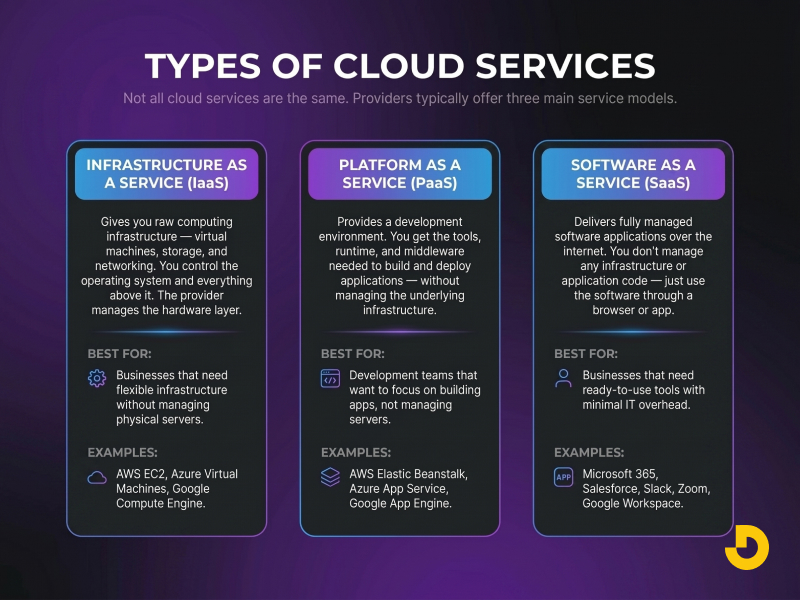
SaaS delivers fully managed software applications over the internet. You don't manage any infrastructure or application code just use the software through a browser or app.
Best for: Businesses that need ready-to-use tools with minimal IT overhead.
Examples: Microsoft 365, Salesforce, Slack, Zoom, Google Workspace.
Beyond service types, cloud infrastructure also comes in different deployment models.
Public cloud resources are owned and operated by the provider and shared across multiple customers (called multi-tenancy). Most small and mid-sized businesses use public cloud because it's cost-effective and easy to set up.
A private cloud is dedicated to a single organization. It can be hosted on-premises or by a third-party provider. Private clouds offer more control and are common in regulated industries like banking and healthcare.
A hybrid cloud combines public and private cloud environments. Organizations use it to keep sensitive data on private infrastructure while running less critical workloads on the public cloud.
Multi-cloud means using services from more than one cloud provider. For example, a company might use AWS for compute, Google Cloud for machine learning, and Azure for enterprise applications.
The shift to cloud computing is not just a trend. There are practical reasons businesses of all sizes rely on cloud service providers.
Not every cloud provider is right for every business. When comparing options, pay attention to these factors.
Where are the provider's data centers located? If your customers are in Europe, running workloads from a US-based data center adds latency. Choose a provider with regional presence close to your users.
Cloud pricing can get complicated fast. Look for transparent billing, cost calculators, and budget alerts. Compare reserved vs. on-demand pricing if you have predictable workloads.
If you handle sensitive data, your provider needs the right compliance certifications. Healthcare companies need HIPAA compliance. Financial services firms need SOC 2. European businesses need GDPR-ready infrastructure.
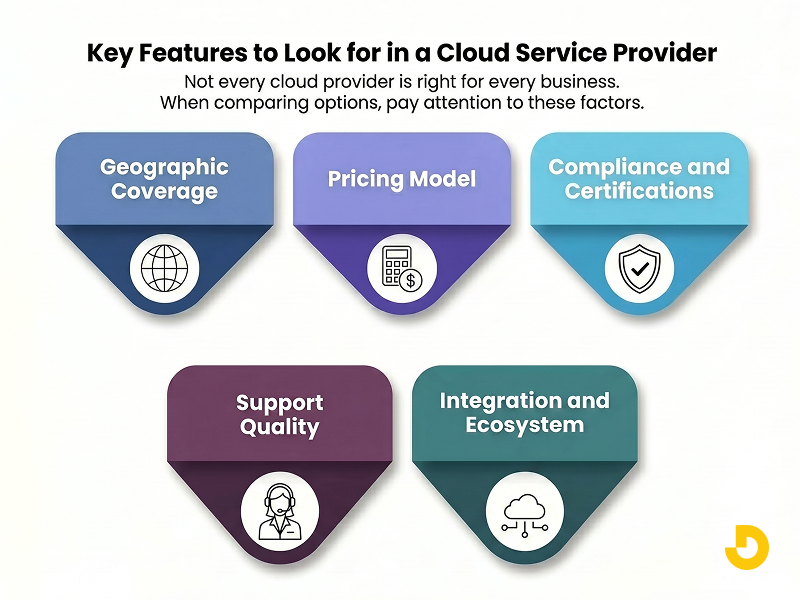
Check what support plans are available and at what cost. Some providers offer 24/7 technical support only on premium tiers. Know what you're getting before you need help.
Does the provider integrate with your existing tools? AWS, Azure, and Google Cloud all have large ecosystems with thousands of third-party integrations. Smaller providers may have a narrower set.
AWS leads in market share, followed by Azure and Google Cloud. Most enterprise workloads run across these three.
Microsoft Azure is strong in Europe due to its enterprise relationships and strong GDPR compliance stance. Sovereign cloud options from European providers like Deutsche Telekom and OVHcloud are growing.
Alibaba Cloud dominates in China. AWS and Google Cloud are strong in Australia, India, Singapore, and Japan.
AWS and Microsoft Azure have been expanding data center presence in the UAE, Saudi Arabia, and South Africa to serve growing regional demand.
At Designocracy, we help clients across different markets identify which provider aligns with their geographic needs and compliance requirements because the right answer genuinely varies by region.
People often pick a provider based on name recognition alone. That's not always the wrong choice, but it's not always the right one either.
Here are mistakes worth avoiding:
For most businesses, yes. The question isn't really whether to use cloud services it's which services and which provider.
If you're running a small business, SaaS tools like Google Workspace or Microsoft 365 might be all you need. If you're running an application or managing your own data infrastructure, IaaS or PaaS makes more sense.
Larger organizations typically use a mix SaaS for productivity tools, IaaS for core infrastructure, and PaaS for development environments.
| Category | Description | Examples | Best For |
|---|---|---|---|
| Infrastructure as a Service (IaaS) | Provides virtual servers, storage, and networking resources over the internet. | AWS EC2, Azure Virtual Machines, Google Compute Engine | Businesses needing scalable infrastructure without physical hardware. |
| Platform as a Service (PaaS) | Offers a development platform with tools and runtime environments. | AWS Elastic Beanstalk, Azure App Service, Google App Engine | Software developers and application teams. |
| Software as a Service (SaaS) | Fully managed applications delivered through the web. | Google Workspace, Microsoft 365, Salesforce, Slack | Organizations seeking ready-to-use software. |
| Public Cloud | Shared cloud infrastructure managed by a provider. | AWS, Azure, Google Cloud | Small and medium-sized businesses. |
| Private Cloud | Dedicated cloud infrastructure for a single organization. | VMware, IBM Cloud Private | Healthcare, finance, and regulated industries. |
| Hybrid Cloud | Combination of public and private cloud environments. | Azure Arc, AWS Outposts | Businesses requiring flexibility and security. |
| Multi-Cloud | Using services from multiple cloud providers. | AWS + Azure + Google Cloud | Large enterprises seeking redundancy and specialization. |
| Top Global Providers | Leading cloud vendors with worldwide infrastructure. | AWS, Microsoft Azure, Google Cloud | Organizations of all sizes. |
| Key Benefits | Scalability, cost savings, security, and reliability. | Pay-as-you-go infrastructure and managed services. | Growing businesses and enterprises. |
Cloud service providers give businesses access to powerful computing infrastructure without the cost and complexity of managing it themselves. Understanding the difference between IaaS, PaaS, and SaaS and knowing how to evaluate providers by coverage, pricing, compliance, and support helps you make a decision that actually fits your situation.
The market is large, the options are many, and no single provider is best for everyone. Start with your actual requirements where your users are, what data you handle, what tools you already use and work forward from there.
At Designocracy, we help businesses make these decisions with clarity. If you're evaluating cloud infrastructure or planning a migration, having the right information from the start saves significant time and cost down the road.