October 9, 2026
10 Best Construction Digital Marketing Agencies in 2026
Top construction digital marketing and SEO agencies featured in industry roundups for 2026 specialize in contractor growth, building materials, and AI search visibility:
Published On: July 13, 2026
Published By: Designocracy
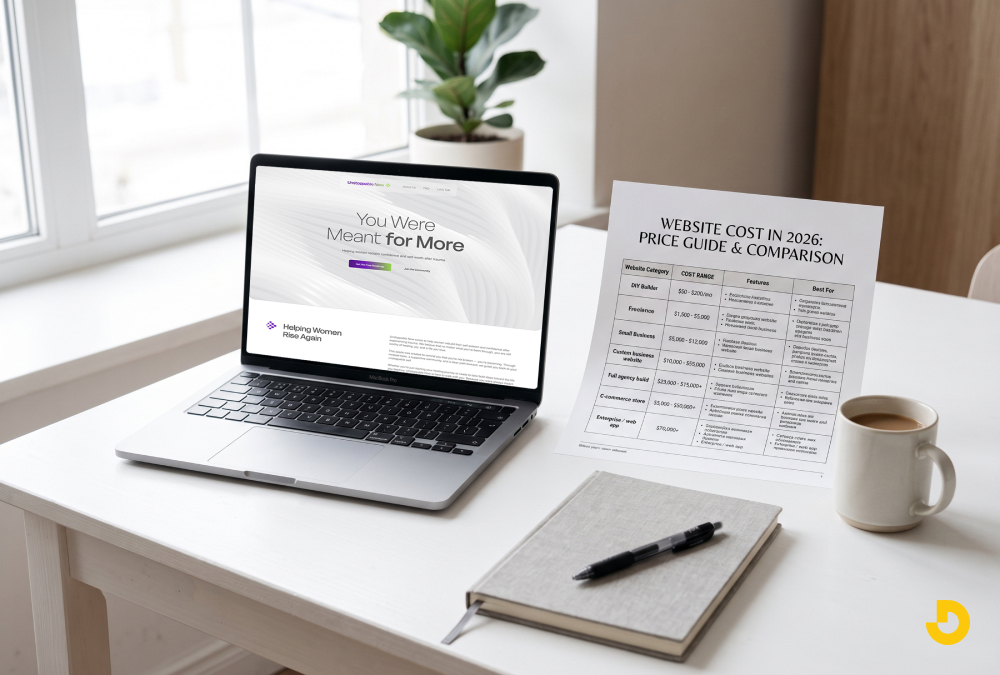
In 2026, a website costs anywhere from under $500 for a DIY builder to $100,000+ for an enterprise build. Most small businesses pay $2,000–$8,000 for a professional site, while custom business websites from an agency typically run $5,000–$50,000. E-commerce stores start around $5,000 and can exceed $40,000. Plan for ongoing costs of roughly 15–30% of your build price each year for hosting, maintenance, and updates.
"How much does a website cost?" is the first question almost every business owner asks, and the honest answer is it depends on what your website needs to do. Someone paid $500 on Fiverr. A competitor spent $80,000 on a redesign. Both are telling the truth, because they bought completely different things.
This guide breaks down real 2026 website design pricing by project type, who builds it, and what drives the number up or down, so you can budget confidently and avoid overpaying (or underpaying and rebuilding in a year).
How to use these numbers: The ranges below are planning estimates based on 2026 industry pricing data from sources including WebFX, OuterBox, and CodeVix. Actual quotes vary by region, scope, and agency. Always get a scoped quote before budgeting.
The single biggest cost driver is who builds your website. Here is what each route realistically costs.
Average website cost by build method (2026)
| Build Method | Upfront Cost | Ongoing Cost | Best For |
|---|---|---|---|
| DIY website builder | $0 – $500 | $15 – $60/mo | Personal projects, testing an idea, very small side businesses |
| Freelance designer | $1,000 – $5,000 | Hourly, as needed | Small businesses wanting custom work on a tight budget |
| Small business site (agency) | $2,000 – $8,000 | $500 – $2,000/yr | Local businesses needing a professional, credible presence |
| Custom business website | $5,000 – $15,000 | $1,000 – $5,000/yr | Growing companies needing a lead-generating site |
| Full agency build | $15,000 – $50,000 | $3,000 – $15,000/yr | Established brands wanting strategy, custom design, and SEO |
| E-commerce store | $5,000 – $40,000+ | Platform fees + maintenance | Online retailers, Shopify and WooCommerce builds |
| Enterprise / web app | $50,000 – $150,000+ | $10,000 – $50,000/yr | Large catalogs, integrations, custom platforms |
Planning ranges based on 2026 industry pricing data. Your quote depends on scope and features.
Platforms like Wix, Squarespace, and WordPress.com bundle hosting, templates, and drag-and-drop editing into a monthly subscription, usually $15–$60 per month. Your first year often lands under $800 all-in.
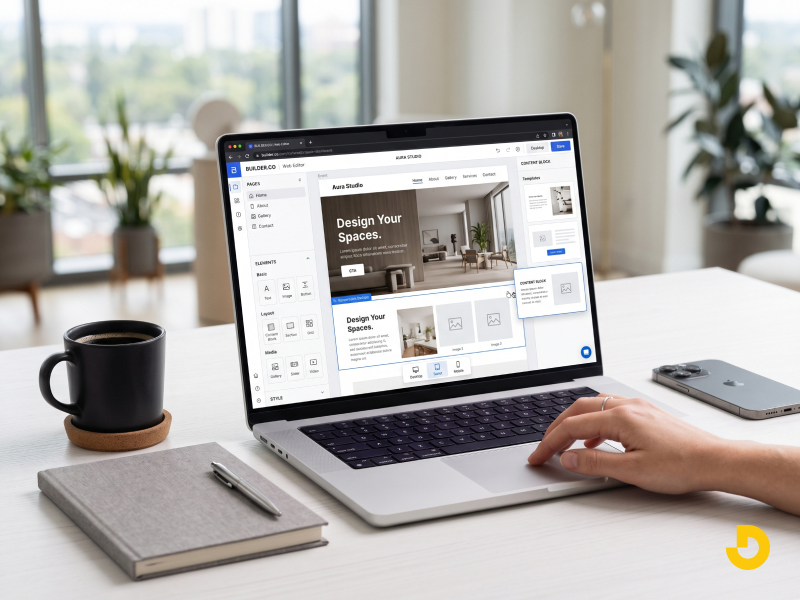
The trade-off: you do all the work—choosing the template, writing the copy, setting up SEO basics, and checking mobile layouts. DIY builders work well for simple sites and early-stage testing, but businesses commonly outgrow them once they need real design flexibility, faster performance, or stronger branding.
Freelance web design rates typically run $15–$100 per hour, with most business projects landing between $1,000 and $5,000. A good freelancer gives you custom work at a fraction of agency cost.
The trade-off: a freelancer is usually one person handling design, development, copy, and SEO. That can mean slower timelines, gaps in specialist skills, and limited support after launch. Vet their portfolio and ask whether they outsource.
This is where most local and small businesses land. For $2,000–$8,000 you typically get a professional 5–10 page site with responsive design, a CMS you can update, contact forms, basic SEO setup, and launch QA. More advanced builds push past $15,000.
This tier buys credibility. It is the difference between a site that looks like a template and one that looks like a real business.
A fully custom website design, built from scratch rather than a template, generally costs $5,000–$15,000 for small and mid-sized businesses. That covers discovery, wireframes, a unique design system, custom development, and conversion-focused UX.
You are not paying for "more pages." You are paying for research, strategy, and a design built to convert your specific audience.
Websites built by a professional agency team of three or more people typically run $15,000–$50,000 in 2026. At this level you get deep discovery, a custom design system, clean development, content strategy, technical SEO, thorough QA, and real post-launch support.
E-commerce website cost depends almost entirely on catalog size and checkout complexity. Smaller stores start around $5,000–$10,000, while larger builds with custom checkout, inventory sync, and ERP integrations reach $40,000–$100,000+. Shopify, WooCommerce, and Magento each carry different platform costs and capabilities.
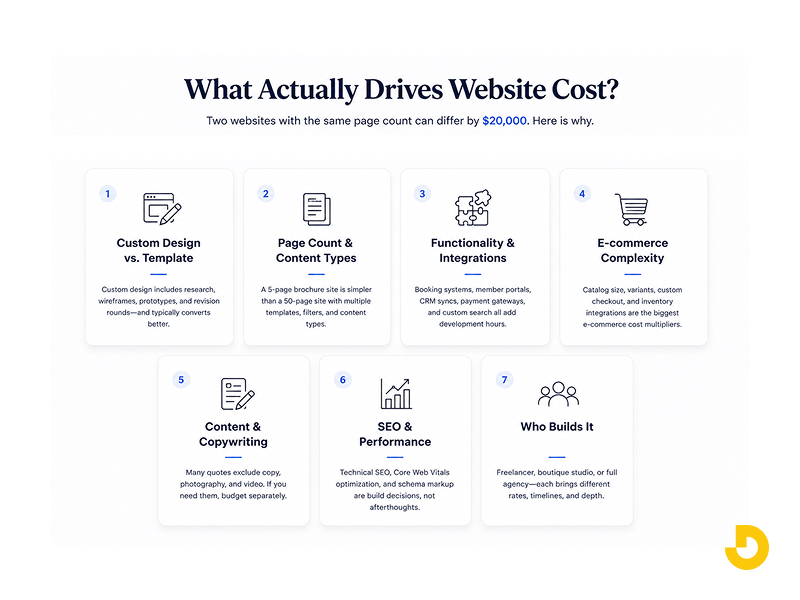
Two websites with the same page count can differ by $20,000. Here is why.
A useful rule of thumb from industry data: design accounts for roughly 30–40% of a project's cost and development 50–60%, with the remainder in QA and launch. On a $10,000 website, that is roughly $3,500 design, $5,500 development, and $1,000 for testing and deployment.
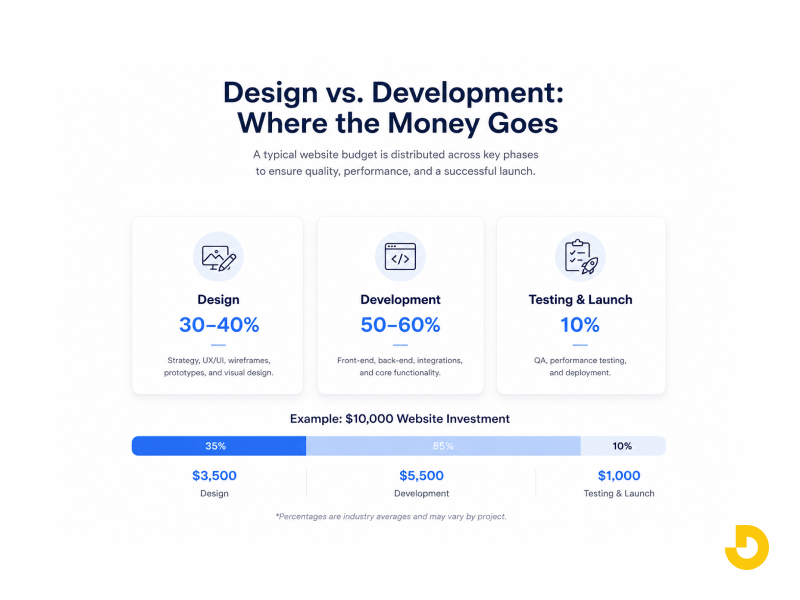
This is why bundling design and development with one team is usually more cost-effective than hiring them separately—nothing gets lost in the handoff.
The build price is only half the story. Most businesses should budget 15–30% of their initial website cost annually to keep the site fast, secure, and visible.
Typical ongoing website costs (2026)
| Ongoing Cost | Typical Price | Why You Need It |
|---|---|---|
| Domain name | $10 – $35/yr | Your web address; renews annually. |
| Web hosting | $2 – $1,000/mo | Cheap hosting slows your site and hurts rankings. |
| SSL & security | $0 – $200/yr | Protects data and is required for trust and SEO. |
| Maintenance & updates | $500 – $5,000/yr | Backups, patches, plugin updates, bug fixes. |
| SEO & content | $500 – $5,000/mo | Ranking and traffic growth — optional but high-return. |
| Platform & apps | Varies | Shopify plans, plugins, booking tools, integrations. |
Skipping maintenance almost always costs more later in fixes, downtime, and lost rankings.
The cheapest quote is rarely the cheapest website. A poorly built site that needs constant fixes, or a full rebuild in 18 months, costs far more than doing it right once.
Before you request quotes, be able to answer three questions: What should the website do after it launches? Who is it for? And what does success look like—leads, sales, or bookings? A clear answer turns a vague $5,000-to-$50,000 range into a real, scoped number.

When comparing proposals, look past the price. Compare what is included: discovery, custom design, content, SEO setup, QA, training, and post-launch support. A $6,000 quote that excludes SEO and copy is not cheaper than an $9,000 quote that includes both.
If you are a small local business, plan for $2,000–$8,000. If you need a custom, lead-generating website, plan for $5,000–$15,000. If you are launching e-commerce, start at $5,000 and scale with your catalog. And whatever you build, set aside 15–30% of that annually to protect the investment.
At The Designocracy, we scope every project transparently—no surprise add-ons, no vague ranges. Tell us what your website needs to do, and we will give you a clear, detailed quote.
Get a restaurant website built to fill tables, not just look good.
Book Your Free Consultation