
September 30, 2026
How to Master SEO for Dentists: A Simple Guide to Getting More Patients
Mastering dental SEO helps your practice rank higher on search engines and turn local online searches into booked patient appointments
Published On: April 2, 2026
Published By: Designocracy
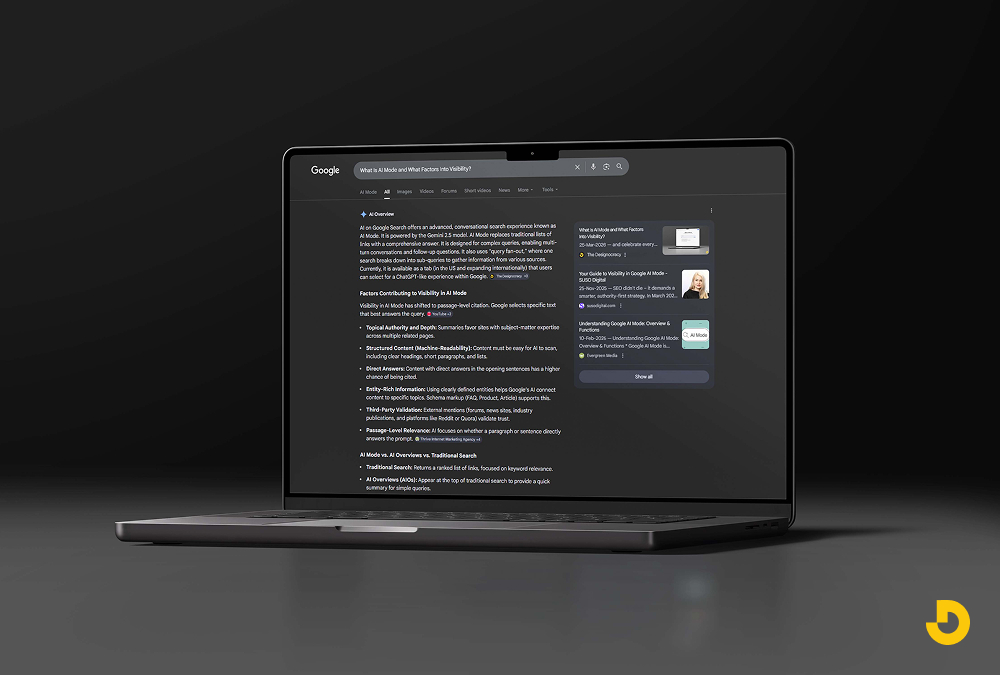
Google's search results now look different. Instead of a list of blue links, you sometimes get a conversation. That's AI Mode. It's a new way Google presents information, and it changes how people find content online. For anyone running a website, understanding AI mode matters. It affects whether your content gets seen.
AI Mode is a conversational search feature from Google that provides natural-language summaries instead of traditional search results. It allows users to ask follow-up questions and refine their search within a single thread. Visibility in AI mode depends on structured content, clear headings, direct answers, and demonstrated authority across related topics. Unlike standard search, AI Mode pulls from content that is formatted for easy summarization and connected through topical clusters.
AI Mode is Google's attempt to make search feel more like a conversation. Instead of typing a query and getting a page of links, you enter a topic and receive a written summary. The system lets you ask follow-up questions. You can clarify what you meant. The conversation continues in one thread.
This is different from a standard Google search. That interface returns a static list of results. AI Mode returns a dynamic answer. It borrows from how messaging apps work. You ask. The AI responds. You ask again. The AI refines the answer.
The shift reflects competition from tools like ChatGPT. But the goal is the same: helping people find useful information. The difference is in how that information is delivered.

People confuse AI Mode with AI Overviews. They are not the same.
AI Overviews appear automatically in regular search results. When you search for something, you might see a box at the top of the page with a short summary. That summary pulls from web sources and appears above the traditional blue links. It's a one-time answer. You see it, and then you scroll down to see more results.
AI Mode is a separate experience. You opt into it. Once inside, the interface is built for back-and-forth questions. You can start with "What is content clustering?" and then ask "How does that help with SEO?" without losing context. The AI remembers what you asked before.
For publishers, this means visibility is no longer just about ranking for a single keyword. AI Mode values content that can answer a chain of related questions. And it values sources that demonstrate authority across a subject, not just one page.

Google hasn't published a formal guide for AI Mode visibility. But early patterns show what matters. The system favors content that is:
Topical depth matters more than before. A page that answers one question well is good. A site that answers ten related questions, with internal links connecting them, is better. AI Mode rewards that kind of interconnected structure.
There's a problem for anyone trying to measure AI Mode performance. Google Search Console does not separate AI Mode data from other traffic. Impressions and clicks from AI Mode are grouped under the general "Web" search type. You cannot filter to see only AI Mode results.
The issue gets worse with analytics tools. AI Mode does not pass referrer data. That means visits from AI Mode show up as "Direct" or "Unknown" in Google Analytics. You know people are coming to your site, but you cannot confirm they came from AI Mode.
This makes ROI measurement difficult. For now, you have to rely on indirect signals. Look for increases in branded search volume. Watch for higher engagement on pages that perform well in AI-driven summaries. Track direct traffic patterns. These are imperfect measures, but they offer clues.
Adapting to AI Mode doesn't require starting from scratch. It means adjusting how you structure and connect your existing content. Here are three practical approaches.
Start with your highest-traffic pages. Review them for elements that help AI summarization:
If a page lacks these elements, it may be overlooked even if the content is strong. Restructuring can make a difference.
AI Mode connects ideas. Your content should do the same.
A content cluster starts with a pillar page. This is a long, detailed guide on a broad topic. Then you create supporting pages that cover specific subtopics. Each supporting page links back to the pillar page. The pillar page links to each supporting page.
For example:
This structure shows Google's AI that your site has depth on the subject. It increases the chance your content will be cited for multiple queries, not just one.
AI Mode mirrors how people actually speak. Content should match that tone.
Use question-based headings. Instead of "SEO Best Practices," use "What Are the Best SEO Practices?" This helps AI identify the exact question your page answers.
Include FAQ sections that anticipate follow-up questions. If you explain "What is AI Mode," the next section should answer "How does AI Mode affect SEO?" These logical connections reflect how users think and how the AI processes information.
At Designocracy, we help clients adapt to changes in search before they become urgent. AI Mode is one of those changes. We focus on building content that works for both human readers and AI-driven summaries.
Our process starts with an audit of existing content. We identify gaps in structure and topical depth. Then we build content clusters that demonstrate authority across subjects. We write with clarity, use headings that match user intent, and structure answers so they can be easily summarized.
We don't chase algorithms. We build foundations that last. And that approach works whether the search result is a blue link or a conversation.
| Visibility Factor | What It Means for AI Mode | Action to Improve |
|---|---|---|
| 🧱 Structured Content | AI Mode prefers pages with clear hierarchy (H2, H3) and answers placed early. Proper headings help the AI extract summaries. | Use descriptive, question-based headings. Keep main answers in the first 2–3 sentences. Break ideas into bullet points or numbered lists. |
| 🎯 Direct Answers | The conversational AI scans for immediate, concise responses. Fluff or delays reduce chance of citation. | Answer the primary query within the first paragraph. Avoid long intros. Use bold or short paragraphs for key statements. |
| 🏛️ Authority & Expertise | AI Mode favors sites with demonstrated depth across multiple pages (not just one article). Topical authority is critical. | Build content clusters: pillar page + supporting articles. Link related pages internally. Show author credentials or domain expertise. |
| 🔗 Topical Depth (Clusters) | Answering one question is no longer enough. AI Mode connects related queries — it rewards interconnected content. | Create topic clusters around core themes. Example: "SEO Guide" (pillar) → keyword research, backlinks, technical SEO (cluster). |
| 💬 Conversational Tone | People speak naturally in follow-up questions. AI Mode mirrors that style. Rigid, keyword-stuffed writing performs worse. | Write like you talk. Use question-based H2s ("What is...?"). Include FAQ sections that anticipate the next logical question. |
| 🔐 Trustworthiness | Google's AI evaluates reputation: established domains, transparent authorship, factual accuracy. | Include author bios, cite sources, maintain consistent publishing. Avoid outdated or contradictory information on the same topic. |
| 📉 Reporting Blind Spots | Search Console doesn't separate AI Mode traffic. No referrer data in analytics — appears as "direct" or "unknown". | Track indirect signals: branded search volume, direct traffic increases, engagement on pillar pages. Monitor rankings for conversational queries. |
AI Mode is not a replacement for traditional search—at least not yet. But it represents a clear direction. Google is moving toward conversational, AI-driven answers. Content that is structured, authoritative, and connected will have the best chance of being seen.
The reporting limitations make it hard to measure impact today. But ignoring the shift is a risk. The sites that invest in clear structure, topical depth, and conversational formats now will be the ones that remain visible as search continues to change.
Whether you manage your own content or work with a partner like Designocracy, the principles are the same. Write clearly. Organize logically. Connect related ideas. And focus on answering the questions people actually ask. That approach has always worked. And it still does, even when the answer comes from AI.